Architecture
The 30-second picture
- 16 microservices organized by business domain. Each owns its data. None share schemas.
- Event bus is NATS JetStream with Quanta's agent contract layered on top.
- Shore cluster runs on RKE2 (public cloud — OCI, AWS, or Azure). Vessel cluster runs on K3s. Same pattern, same charts, two scales.
- Identity is Zitadel (OIDC / OAuth2). One IDP across all domains.
- API gateway is Kong Gateway OSS. Same deployment shore and onboard.
- Networking + policy + observability is Cilium (CNI, WireGuard, Hubble). No separate service mesh in Phase 1–3.
- Database per service is PostgreSQL via the CloudNativePG operator.
- Frontends are React PWA (POS / kiosk / iTV / signage) and React Native (mobile) — one codebase, multiple form factors.
- Comms is ConnectOne (PBX + signaling + media) with CallCraft as the AI-voice surface inside it.
- AI fabric is Quanta. Content safety + analysis is Heimdall.
- Privacy is per-tenant region pinning, GDPR-grade by default, crypto-erasure for non-deletable stores.
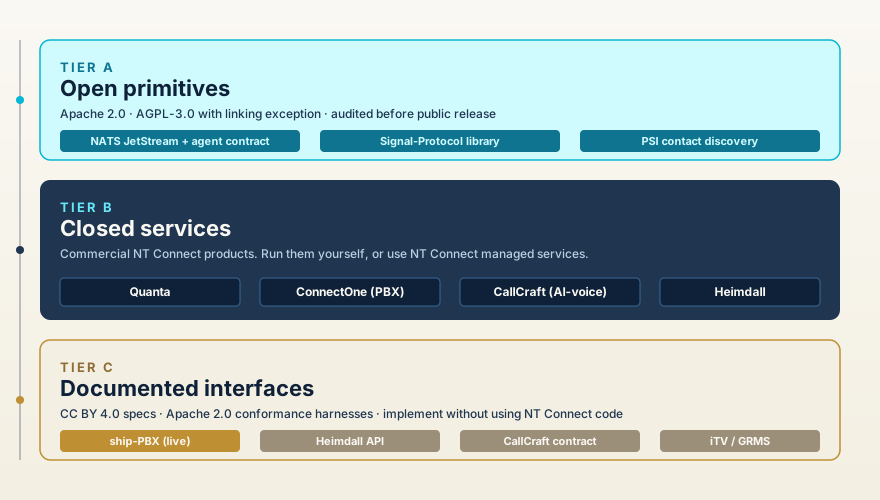
Three-tier integration model
Nautilus is organized into three tiers with different licensing and openness postures. The model is designed so any third party can build a Nautilus-compatible integration without running a single line of NT Connect's commercial code.
Tier A — Open primitives
Permissively licensed. Foundational. Everyone uses these.
| Primitive | License | What it is |
|---|---|---|
| NATS JetStream + Quanta agent contract | Apache 2.0 | The bus (NATS) and the JetStream subject + stream contracts (AGENT_MESSAGES / AGENT_RESPONSES, cross-account sourcing for tenant isolation, agent JWT semantics). |
| Signal-Protocol library | AGPL-3.0 with linking exception (libsignal pattern) | The end-to-end encryption library underlying secure messaging. |
| PSI contact-discovery module | Apache 2.0 | Private set intersection for contact discovery. |
Tier B — Closed services
Commercial NT Connect products. Run them yourself via the published interfaces, or use NT Connect's managed services.
- Quanta — auth, messaging-service, keys-service, websocket-gateway, push, media, group, admin, video.
- ConnectOne — Cloud PBX, signaling, media platform.
- CallCraft — AI-voice agent runtime inside ConnectOne.
- Heimdall — DeBERTa-v3 multi-task analysis service + 12 content-safety plugins.
Tier C — Documented interfaces
Anyone can implement against these specs and integrate without using NT Connect's closed services. Spec text is CC BY 4.0; reference stubs and conformance harnesses are Apache 2.0.
- ship-PBX integration — live (Draft v0.1). Legacy PBX (Avaya / Mitel / Cisco / Alcatel / Asterisk / FreeSWITCH) ↔ Nautilus bus for call events, PA/GA, E911, recordings, commands.
- Heimdall content-safety API — coming next.
- CallCraft agent contract — extends the Quanta agent contract with voice/video-session semantics.
- ConnectOne E911 / PA-GA / muster signaling.
- Quanta keys-service protocol.
- iTV / cabin GRMS adapter contract.
- Fleet-wide federation.
The bus
The bus is NATS JetStream v2.10+ (with -js enabled), running cross-account so tenants are isolated by JetStream sourcing rather than by namespace. Quanta's agent contract layers on top:
AGENT_MESSAGES— outbound stream of events that AI agents may consume.AGENT_RESPONSES— agent outputs flowing back to the platform.- Cross-account JetStream sourcing per tenant.
- Agent JWT semantics for capability scoping.
Every domain event is observable to AI agents by construction. This is what we mean when we say "AI as fabric, not bolt-on."
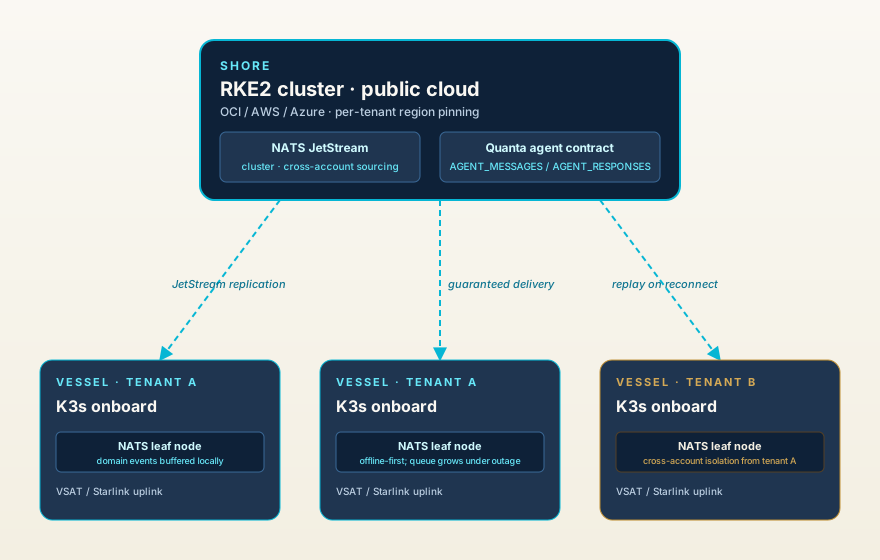
Ship ↔ shore sync
Onboard NATS leaf node replicates JetStream streams to the shore cluster with guaranteed delivery and replay-on-reconnect. When the VSAT / Starlink uplink is degraded:
- Onboard domains keep publishing events locally.
- Shore replication queue grows.
- On reconnect, the queue drains in order; idempotent consumers reconcile.
No batch jobs. No "end-of-day sync." Operational reality is reflected in the fleet dashboard live, with replay catching up degraded vessels.
Per-tenant region pinning
Privacy is the global default, regardless of tenant jurisdiction. GDPR-grade controls are baseline; tenants in other jurisdictions inherit them rather than getting weaker protections.
- Each tenant is pinned to a shore region at onboarding.
- Operational data stays in-region.
- Heimdall has per-region SafeSpace deployments with metadata-only cross-border flow to a single consolidation region for analytics — not full content.
- DSR APIs (access / rectify / erase / port / restrict / object) are first-class endpoints in Domain 1.
- Crypto-erasure for non-deletable stores (audit logs, blockchain-style append-only ledgers).
- Per-category retention configured per jurisdiction.
- DPIA per tenant authored at onboarding.
- No secondary use of operational data without explicit renewed consent.
Diagram: Tenant A pinned to EU region. Tenant B pinned to US region. Heimdall SafeSpace per-region; metadata-only flow to consolidation region. DSR APIs in Domain 1.
Vessel deployment topology
A vessel is a K3s cluster running the same Helm charts as the shore cluster, with a few cruise-specific additions.
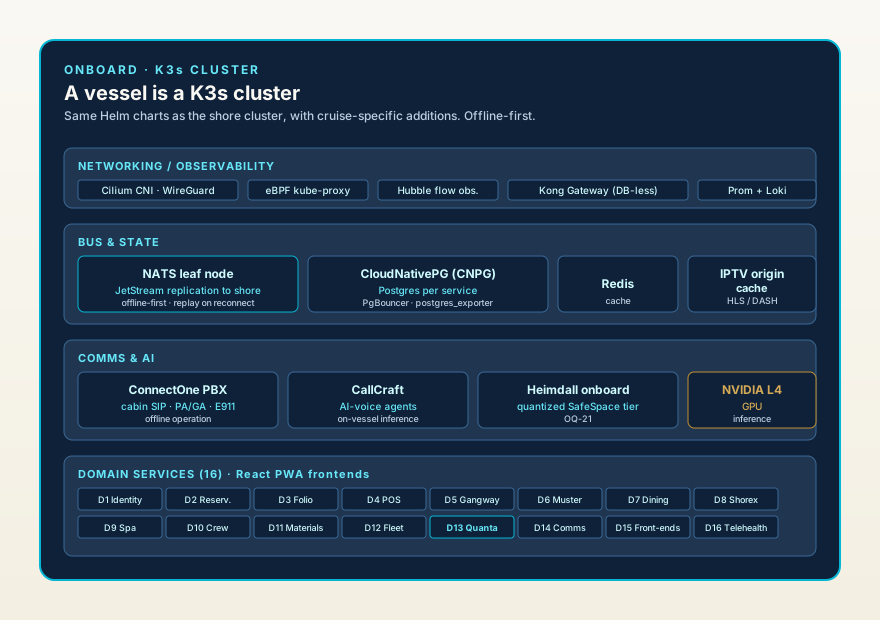
Onboard cluster components:
- K3s control plane.
- Cilium CNI — kernel ≥ 5.15 required, eBPF kube-proxy replacement, WireGuard transparent encryption,
CiliumNetworkPolicyfor identity-based authz, Hubble flow observability. - CloudNativePG operator with one Postgres cluster per domain service. PgBouncer in front of the primary;
postgres_exporter+ ServiceMonitor mandatory. - NATS leaf node replicating JetStream streams to shore.
- Kong Gateway OSS in DB-less mode with
decKdeclarative config under GitOps. - ConnectOne PBX running locally so onboard calls survive uplink loss.
- CallCraft agent runtime for onboard AI-voice (offline-capable for safety paths).
- Heimdall onboard module — quantized SafeSpace tier per OQ-21, sized to onboard hardware.
- signsync for fleet-wide signage.
- IPTV origin cache for the iTV stack.
- NVIDIA L4 GPU (typical sizing) for the onboard Heimdall and CallCraft inference workloads.
CallCraft + AI agents
Diagram: AI agents joining ConnectOne calls / rooms via
AGENT_MESSAGES/AGENT_RESPONSESstreams, with Quanta orchestrating intent dispatch and the agents posting back into Domains 3 (folio), 4 (POS), 7 (dining), 8 (excursions), 16 (telehealth) as appropriate.
A CallCraft agent is a first-class participant in a ConnectOne call or room. It joins via the Quanta agent contract, consumes audio + signaling, and produces:
- AI Notes summaries on every call (configurable per tenant).
- Voice intents routed back into the relevant domain — voice ordering posts a Domain 4 POS event; concierge booking posts a Domain 8 excursion event.
- Sentiment and content analysis via Heimdall, applied to call audio per tenant policy.
- AI-guided mustering instructions during emergency, over the ConnectOne PA/GA tier.
There is no separate SIP / WebRTC stack inside any SPMS domain. The transport is ConnectOne; the AI is CallCraft; both communicate over the bus.
Domain interaction map
Diagram: 16 domains as event publishers / subscribers. Sample flows: gangway scan → Domain 5 publishes embark event → Domain 6 muster updates → Domain 14 PA system gets crew acknowledgment via CrewApp → Domain 12 fleet dashboard updates live.
A handful of canonical event flows make the model concrete:
- Guest scans card at gangway. Domain 5 publishes
embark.scanned. Domain 6 muster updates the live headcount. Domain 12 fleet dashboard reflects the new gangway count. Heimdall (via Domain 13) analyzes the access pattern for anomalies. - Waiter posts an order. Domain 4 publishes
pos.order.created. Domain 3 posts the line to the folio. Domain 11 decrements inventory. Domain 7 emits anorder.firedevent for the KDS. Domain 13 updates the predictive-spend model for the guest. - Guest dials cabin extension and asks for room service. Domain 14 ConnectOne routes the call. CallCraft joins as an agent. CallCraft publishes
pos.order.createdon the guest's behalf. Domain 3 posts to folio. Domain 7 fires the order on the KDS. Domain 13 captures the intent for voice-pattern analysis. - Operator changes a venue menu in the CMS. Domain 7 publishes
menu.updated. Domain 15 signage subscribers redraw all menu boards in the affected venue within seconds. Domain 4 POS terminals refresh. Domain 13 updates the recommendation index.
What we're explicitly not doing
- No service mesh in Phase 1–3. Cilium covers CNI, encryption, policy, and observability. Linkerd / Istio are tracked as future-evaluation only.
- No MongoDB or Couchbase in Nautilus. Postgres JSONB covers the flexible-schema needs.
- No Oracle DB. No Oracle MICROS terminals. Commodity hardware throughout.
- No batch ship-to-shore sync. Event-stream replication only.
- No proprietary PBX. ConnectOne is the platform; legacy on-vessel PBXes integrate via the Tier-C ship-PBX spec.
- No closed CSAM-detection black box. Heimdall's CSAM path uses PhotoDNA + Thorn with NCMEC reporting per 18 USC 2258A; it's auditable.
- No "AI-powered" without naming the model. DeBERTa-v3-large for analysis; named LLM agents per task; quantized variants onboard.